
Table of Contents
Abdominal pain can occur due to indigestion, constipation, gas, food-related problems, or infections. However, persistent or worsening abdominal pain should not be ignored. One important cause is appendicitis, in which the appendix becomes inflamed and may lead to complications without appropriate medical evaluation and treatment.
A typical pattern may begin with discomfort around the belly button and later move toward the lower right side of the abdomen. However, symptoms vary depending on age, pregnancy, and the position of the appendix.
In this article, we explain common appendicitis symptoms, appendix pain symptoms, how appendicitis differs from gas pain, when lower right abdominal pain may require urgent attention, and options for appendicitis treatment in Solapur.
If abdominal pain is severe, worsening, or associated with repeated vomiting, fever, fainting, or severe weakness, seek prompt medical assessment. You can also read our guide on Emergency Abdominal Pain: 10 Warning Signs You Should Never Ignore.
What Is Appendicitis?
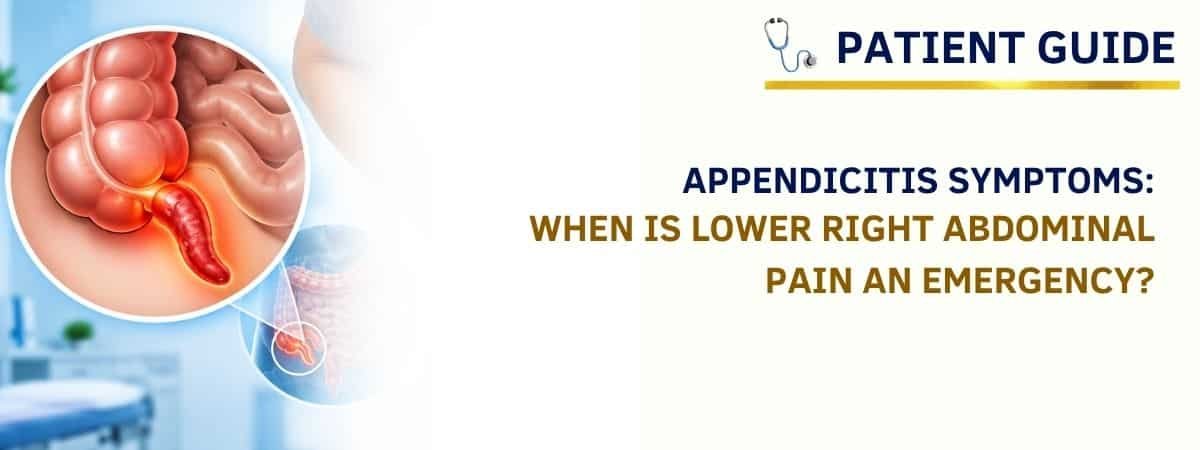
Appendicitis is inflammation of the appendix, a small tube-like pouch connected to the large intestine. When the appendix becomes blocked or inflamed, bacteria can multiply inside it, causing swelling and increasing pressure.
Without appropriate treatment, severe inflammation can result in perforation, abscess formation, or infection spreading within the abdomen.
Treatment depends on:
- Severity and duration of symptoms
- Physical examination findings
- Blood and urine test results
- Imaging findings
- Whether the appendix has ruptured
- Presence of an abscess or other complication
- Overall health
Patients in Solapur with suspected appendicitis may require assessment through Emergency General Surgery services, especially when symptoms are severe or rapidly worsening.
Where Is the Appendix Located?
The appendix is usually located in the lower right part of the abdomen, near where the small intestine joins the large intestine. Its exact position can vary, so appendicitis symptoms do not always appear in the same way.
Pain may occur mainly in the lower right abdomen, begin around the belly button, or appear elsewhere. During pregnancy, the growing uterus can also change the position of abdominal organs. Therefore, pain location alone cannot confirm or rule out appendicitis.
What Are the Common Appendicitis Symptoms?
Common appendicitis symptoms include:
- Abdominal pain that increases over time
- Pain beginning near the belly button
- Pain moving toward the lower right abdomen
- Loss of appetite
- Nausea or vomiting
- Fever
- Abdominal tenderness
- Pain that worsens with movement or coughing
- Abdominal bloating
Not every patient experiences every symptom. Children, older adults, and pregnant women may have less typical symptoms. Persistent or worsening abdominal pain should be medically assessed rather than repeatedly treated as gas or indigestion.
The Typical Pattern of Appendix Pain Symptoms
Pain May Begin Near the Belly Button
Early discomfort may feel like a dull ache, cramping, stomach pain, or indigestion. At this stage, identifying the exact cause can be difficult.
Pain May Move Toward the Lower Right Abdomen
As inflammation progresses, pain may become more localised to the lower right side. This is one of the better-known appendix pain symptoms. Walking, coughing, sneezing, or movement may increase discomfort, although this pattern does not occur in every case.
Pain May Become Persistent or Severe
Appendicitis pain may continue to worsen rather than improving with rest, passing gas, or dietary changes. Concern is greater when pain occurs with fever, repeated vomiting, loss of appetite, increasing tenderness, weakness, or feeling unwell.
When Is Lower Right Abdominal Pain an Emergency?
Not all lower right abdominal pain is caused by appendicitis. However, seek urgent medical attention if abdominal pain:
- Becomes progressively worse or severe
- Remains persistent
- Moves from around the belly button to the lower right abdomen
- Occurs with repeated vomiting or fever
- Makes movement difficult
- Is associated with significant abdominal swelling
- Is accompanied by fainting, confusion, or severe weakness
These symptoms do not automatically mean appendicitis, but they should be assessed promptly. If urgent surgical evaluation is required, patients may need Emergency Abdominal Surgery services in Solapur.
Appendicitis vs Gas Pain: How Can You Tell the Difference?
Gas pain and appendicitis can sometimes feel similar, particularly during early stages.
| Feature | Appendicitis | Gas Pain |
| Pain pattern | Often progressively worsens | Often comes and goes |
| Location | May move toward lower right abdomen | Can occur in different areas |
| Appetite | Loss of appetite may occur | Usually not a major feature |
| Nausea/vomiting | May occur | Less commonly severe |
| Fever | Can occur | Usually not typical |
| Relief after passing gas | Usually no lasting relief | Often improves |
This is only a general guide and cannot diagnose abdominal pain. Persistent or worsening pain should be medically evaluated.
Other Conditions That Can Cause Lower Right Abdominal Pain
Other possible causes include:
- Intestinal problems
- Urinary tract conditions
- Kidney stones
- Gastrointestinal infections
- Inflammatory bowel conditions
- Hernias
- Gynaecological conditions in women
Severe pain, vomiting, or abdominal distension may require evaluation for intestinal obstruction. See Intestinal Obstruction Surgery in Solapur. A painful swelling associated with a hernia may also require surgical assessment; learn more about Hernia Surgery in Solapur.
Why You Should Not Ignore Worsening Appendix Pain Symptoms
Appendicitis can progress and may cause:
- Perforation or rupture
- Abscess formation
- Infection within the abdominal cavity
- Serious systemic illness
There is no fixed or safe waiting period that applies to every patient. Worsening appendicitis symptoms should therefore be assessed promptly.
How Is Appendicitis Diagnosed?
There is no single symptom that confirms appendicitis in every patient. Doctors generally consider:
- Symptoms and their timeline
- Physical examination
- Blood and urine tests
- Imaging studies when appropriate
Ultrasound uses sound waves to create images and may be useful in children and pregnant patients, although the appendix is not always clearly visible. A CT scan can provide detailed abdominal images and may help identify an inflamed appendix, perforation, abscess, intestinal obstruction, or other causes of pain. For selected gastrointestinal conditions, see Gastrointestinal (GI) Surgery in Solapur.
What Are the Treatment Options for Appendicitis?
Treatment depends on whether appendicitis is uncomplicated or complicated. Options may include:
- Surgery
- Antibiotics in selected cases
- Drainage of an abscess in certain situations
- Supportive hospital care
Appendectomy, or surgical removal of the appendix, has traditionally been the standard treatment. Selected patients with uncomplicated appendicitis may sometimes be treated initially with antibiotics.
Treatment decisions may depend on perforation, abscess, appendicolith, severity of infection, imaging findings, and overall health. Patients should not attempt to self-treat suspected appendicitis at home. For more information, visit Appendix Surgery and Appendicitis Treatment in Solapur.
What Is an Appendectomy?
An appendectomy is surgery to remove the appendix. It may be performed using:
- Laparoscopic surgery
- Open surgery
Laparoscopic surgery uses a camera and specialised instruments through small incisions. In suitable cases, potential advantages include smaller incisions, less tissue trauma, reduced postoperative discomfort, earlier mobility, and shorter recovery.
Open surgery uses an abdominal incision and may be considered for a ruptured appendix, extensive infection, difficult anatomy, severe inflammation, or certain emergency situations. In some cases, laparoscopic surgery may be converted to open surgery if this is safer. Learn more about Laparoscopic (Keyhole) Surgery in Solapur.
What Happens If the Appendix Ruptures?
A ruptured or perforated appendix is a serious complication because infection can spread into the abdominal cavity. Possible complications include peritonitis, abscess, severe infection, and sepsis in serious cases.
Treatment may involve hospitalisation, intravenous fluids, antibiotics, drainage procedures, and surgery depending on the condition. More complex cases may require Surgical Critical Care for Critically Ill Patients in Solapur.
An appendiceal abscess is a collection of pus around the appendix. Depending on its size, location, and the patient’s condition, treatment may include antibiotics, image-guided drainage, or surgery.
Common Myths About Appendicitis
Myth 1: Appendicitis always causes lower right abdominal pain.
Fact: Pain may begin around the belly button or appear differently depending on the appendix position.
Myth 2: If the pain improves, the problem is gone.
Fact: Temporary improvement does not reliably confirm that the underlying problem has resolved.
Myth 3: Appendicitis can be diagnosed at home.
Fact: Physical examination, blood tests, urine tests, and imaging may be required.
Myth 4: Every case is treated the same way.
Fact: Treatment depends on whether appendicitis is uncomplicated or complicated. Some patients may be considered for antibiotics, while others require surgery.
Myth 5: Laparoscopic surgery is suitable for everyone.
Fact: The choice between laparoscopic and open surgery depends on the clinical situation. See Laparoscopic (Keyhole) Surgery in Solapur.
Appendicitis Treatment in Solapur: When to Seek Surgical Advice
If you have persistent or worsening appendicitis symptoms, timely medical evaluation is important. Do not wait for lower right abdominal pain to become unbearable before seeking help.
Dr. Vijay Shivpuje, Consultant Surgeon & Chief of Surgical Services at Yashodhara Super Speciality Hospital, Solapur, provides evaluation and surgical care for conditions affecting the appendix and other abdominal organs.
For non-emergency consultation needs, you can book an appointment with Dr. Vijay Shivpuje.
Conclusion: Do Not Ignore Worsening Appendicitis Symptoms
Lower right abdominal pain does not always mean appendicitis, but appendicitis symptoms should never be ignored when pain is persistent, worsening, or associated with nausea, vomiting, fever, loss of appetite, or significant abdominal tenderness.
The classic pattern of pain moving from around the belly button toward the lower right abdomen can be an important warning sign, but symptoms can vary. The safest approach is not to diagnose severe abdominal pain at home. A proper medical evaluation can determine whether the cause is appendicitis or another abdominal condition.
If you are experiencing persistent appendix pain symptoms or need advice regarding appendicitis treatment in Solapur, consult Dr. Vijay Shivpuje, Consultant Surgeon & Chief of Surgical Services at Yashodhara Super Speciality Hospital, Solapur.
📞 Appointment: +91 94220 69801
You can also book an appointment with Dr. Vijay Shivpuje.
FAQs
1. What are the first appendicitis symptoms?
Early symptoms may include vague abdominal discomfort near the belly button, loss of appetite, nausea, or mild abdominal pain. Symptoms may worsen over time.
2. Where does appendix pain usually occur?
The appendix is commonly located in the lower right abdomen. Pain may begin around the belly button and later move toward the lower right side, although this pattern is not present in every patient.
3. Can appendicitis symptoms come and go?
Abdominal discomfort can fluctuate, but suspected appendicitis should not be judged only by temporary improvement. Persistent or worsening symptoms require medical assessment.
4. How quickly can appendicitis become serious?
Progression varies between individuals. There is no fixed timeline that safely predicts complications. Severe or worsening symptoms should be evaluated promptly.
5. Can you have appendicitis without fever?
Yes. Fever may occur, but not every patient develops noticeable fever, particularly during early stages.
6. Can gas cause pain similar to appendicitis?
Gas can cause abdominal discomfort, but persistent or progressively worsening pain should not automatically be considered gas. Medical evaluation is the safest way to determine the cause.
7. Is lower right abdominal pain always appendicitis?
No. Kidney stones, urinary problems, intestinal conditions, hernias, infections, and other conditions can also cause lower right abdominal pain.
8. Is surgery always required for appendicitis?
Not always. Selected patients with uncomplicated appendicitis may sometimes be considered for antibiotic treatment, while many patients may require appendectomy.
9. What is an appendectomy?
An appendectomy is surgery to remove the appendix. It may be performed through laparoscopic or open surgery depending on the patient’s condition.
10. When should I seek emergency care?
Seek prompt medical attention for severe or worsening abdominal pain, repeated vomiting, fever, significant tenderness, difficulty moving, fainting, severe weakness, or other concerning symptoms.
